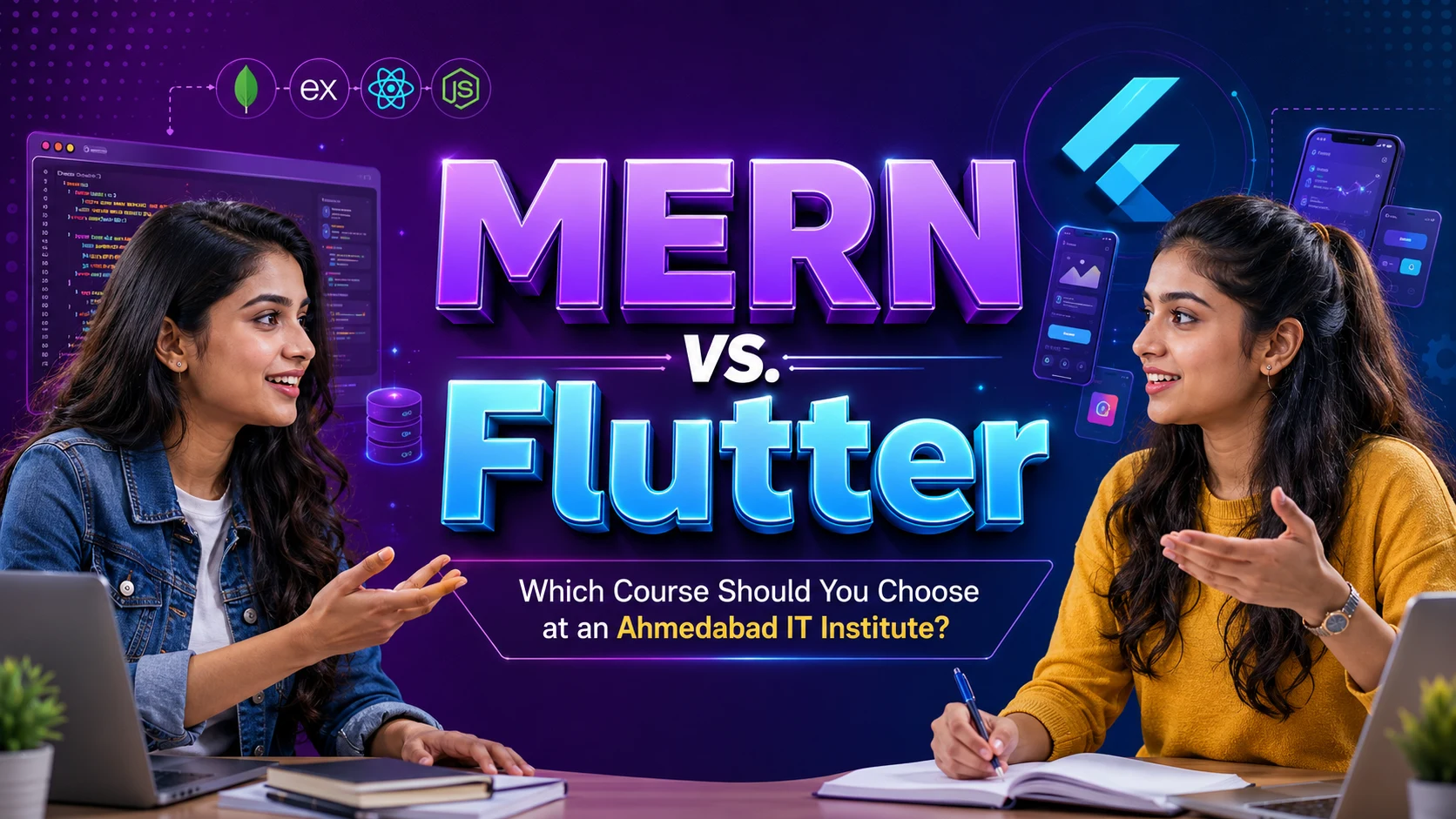
MERN vs. Flutter: Which Course Should You Choose at an Ahmedabad IT Institute?
The Course Choice That Can Shape Your Tech Career
Choosing between MERN and Flutter can feel like standing at a busy Ahmedabad crossroads during peak traffic. One road takes you toward full-stack web development, where you build websites, dashboards, admin panels, APIs, and complete web applications. The other road takes you toward app development, where you create smooth mobile apps that run on Android and iOS with a single codebase. Both roads are useful, both are in demand, and both can lead to strong career opportunities. The real question is not which technology is “better” in a general sense, but which one is better for your career goals, learning style, and future plans.
For students and career changers in Ahmedabad, this decision matters even more because the city has become a strong IT education and service hub. You will find institutes offering web development, mobile app development, design, digital marketing, data analytics, and many other technology courses. That sounds exciting at first, but it also creates confusion. Every institute says its course is job-oriented. Every counselor says their syllabus is industry-ready. Every technology seems to promise a bright future. So, naturally, students ask the same question again and again: should I learn MERN or Flutter?
The honest answer is simple but layered. MERN is a strong choice if you want to become a full-stack web developer and understand both frontend and backend development. Flutter is a strong choice if you want to become a mobile app developer and build attractive, fast, cross-platform apps. MERN teaches you how web applications work from browser to server to database. Flutter teaches you how mobile interfaces behave, how screens respond, and how apps feel in users’ hands. One is like learning to build a complete house with rooms, plumbing, wiring, and security. The other is like learning to design a modern vehicle that must look good, move smoothly, and perform well on different roads.
This blog will help you compare both options from a practical Ahmedabad student’s point of view. We will look at skills, learning difficulty, projects, job roles, salary growth, local market demand, and long-term career value. By the end, you should have a much clearer idea of which course fits you better at an Ahmedabad IT institute.
A Student’s Guide to IT Internships in Ahmedabad
Understanding MERN Stack Before You Join a Course
MERN is one of the most popular stacks for modern web development because it helps developers build complete web applications using JavaScript-based technologies. The word MERN stands for MongoDB, Express.js, React.js, and Node.js. Together, these tools help you create the frontend, backend, server logic, and database layer of an application. That means a MERN developer is not limited to only designing web pages or only writing backend code. A good MERN developer can understand how the entire web application works, from the button a user clicks to the data saved in the database.
This is why many students in Ahmedabad choose MERN when they want a broad and flexible software development career. Web development is everywhere. Every business needs a website, every startup needs a web app, every coaching class wants a student portal, every hospital wants appointment booking, every retailer wants an online store, and every service company wants an internal dashboard. MERN fits many of these needs because it is fast, scalable, and widely used in real-world projects. It also helps that JavaScript is used across the stack, which means students do not have to jump between many unrelated programming languages at the beginning.
A MERN course usually starts with the basics of HTML, CSS, JavaScript, and responsive design before moving into React. Then students learn how to create backend APIs using Node.js and Express.js. After that, they learn how to store and manage data using MongoDB. The course often ends with authentication, deployment, Git, hosting, and complete project building. This makes MERN a strong choice for students who want to understand the “full picture” of web development rather than learning only one small part.
However, MERN also demands patience. Since it includes multiple technologies, beginners may feel overloaded in the first few weeks. You are not only learning how to code; you are learning how frontend talks to backend, how backend talks to database, how APIs work, how user login works, and how errors travel through the application. But once the pieces start connecting, MERN becomes very rewarding. It gives you the confidence to build real products, not just practice pages.
What MERN Really Means
MERN is not just four technologies placed together for branding. It is a complete development system that supports modern web applications. MongoDB works as the database where information is stored, such as users, products, orders, messages, or course records. Express.js works like the traffic controller of the backend, helping manage requests and responses. React.js handles the user interface, which is the part people see and interact with. Node.js allows JavaScript to run on the server, making it possible to build backend logic with the same language used on the frontend.
Think of MERN like a restaurant. React is the dining area where customers sit, order, and experience the service. Node and Express are the kitchen and staff coordination system where orders are processed. MongoDB is the storage room where ingredients and records are kept. If one part fails, the whole restaurant experience suffers. This is why MERN training teaches you how all parts communicate instead of treating web development as isolated design work.
For a beginner, this full-stack structure is powerful because it makes you understand what actually happens behind a website. When someone logs into an app, you learn how the form collects data, how the backend checks the user, how the database confirms the record, and how the frontend updates the screen. These are real skills used in real companies. You are not simply learning theory; you are learning how applications behave in the real world.
Another big advantage is that MERN is heavily connected to JavaScript. Once you become comfortable with JavaScript, you can use it in many places. You can write frontend code, backend code, validation logic, API handling, and even some automation scripts. This makes MERN attractive for students who want one language to open many doors. It also gives you a strong base if you later want to learn Next.js, TypeScript, React Native, or other modern development tools.
What You Learn in a MERN Course
A well-structured MERN course at an Ahmedabad IT institute should not throw React and Node at you from day one without building your foundation. The better learning path usually begins with web basics. You start with HTML to understand structure, CSS to manage design, and JavaScript to control logic. These may look simple at first, but they are the roots of everything you do later. Weak basics can make advanced development feel like trying to build a tower on wet sand.
After the basics, React becomes the main frontend focus. You learn components, props, state, hooks, routing, forms, API calls, and reusable UI patterns. This is where web development starts feeling alive because you are no longer making static pages. You are building interfaces that react to user actions, show data, validate inputs, and update without reloading the page. React can feel strange at first because it asks you to think in components, but once you understand the pattern, it becomes smooth and enjoyable.
Then comes backend development with Node.js and Express.js. This is where many students discover that web applications are not only about what users see. You learn routes, controllers, middleware, authentication, authorization, file uploads, email integration, and error handling. You also learn how APIs work, which is one of the most important skills in modern software development. APIs are like bridges between systems. Without them, frontend and backend would be two people shouting across a river with no way to meet.
MongoDB completes the stack by teaching you how to store and retrieve data. You learn collections, documents, schemas, queries, relationships, and database design basics. A strong course should also include Git, GitHub, deployment, hosting, environment variables, and project documentation. These finishing skills matter because companies do not only want students who can code on a classroom computer. They want developers who can manage code, collaborate, deploy projects, and solve practical problems.
Understanding Flutter Before You Join a Course
Flutter is a development framework created for building cross-platform applications with a single codebase. In simple words, it allows developers to create apps for Android, iOS, web, and sometimes desktop using one main code structure. The programming language used with Flutter is Dart. For students who dream of seeing their app on a mobile screen, Flutter feels exciting because the results are visual, fast, and easy to demonstrate. You write code, press run, and quickly see a beautiful interface appear on an emulator or phone.
Mobile apps have become part of everyday life. People order food, book cabs, pay bills, attend classes, watch videos, track fitness, shop online, and manage work through apps. Because of this, app development has strong appeal for students who want to build user-facing products. Flutter is popular because it reduces the need to build separate Android and iOS apps using different technologies. For businesses, this can save time and cost. For developers, it creates a focused learning path.
At an Ahmedabad IT institute, Flutter is usually taught as a mobile app development course. Students learn Dart basics, Flutter widgets, layouts, navigation, forms, state management, API integration, local storage, Firebase, animations, and app deployment basics. Flutter is especially attractive for students who enjoy design, screen flow, user experience, and visual feedback. It feels more like shaping clay into a polished product because you constantly see how your code changes the look and behavior of the app.
Still, Flutter is not only about making pretty screens. Good Flutter development requires logic, architecture, performance awareness, backend integration, testing, and deployment understanding. A basic app may be easy to build, but a professional app needs clean code, reusable widgets, proper state management, secure API handling, and smooth performance. So while Flutter may look easier in the beginning, it still needs serious practice if you want to become job-ready.
What Flutter Really Means
Flutter is often described as a UI toolkit, but that description can feel too small for what it actually offers. It gives developers a complete way to build mobile app interfaces and functionality with consistent behavior across platforms. Instead of depending fully on native UI components, Flutter draws much of its own interface. This gives apps a consistent look and feel, which is one reason Flutter apps can appear smooth and polished when built correctly.
The heart of Flutter is its widget system. Almost everything in Flutter is a widget: text, buttons, images, rows, columns, containers, screens, forms, and even spacing. At first, this may sound odd. But once you get used to it, the widget system feels logical. You stack small pieces together to create bigger pieces, just like assembling furniture from well-cut parts. A button sits inside a container, a container sits inside a column, a column sits inside a screen, and the full app becomes a tree of widgets.
Dart is the language behind Flutter. It is not as commonly known among beginners as JavaScript, but it is clean and structured. Students who have learned basic programming concepts can usually pick it up with consistent practice. Dart supports object-oriented programming, asynchronous operations, collections, functions, and modern syntax. For app development, this matters because mobile apps constantly deal with events, user actions, data fetching, and screen updates.
Flutter also has strong appeal for startups and service companies because it helps teams move faster. Instead of hiring separate Android and iOS developers for early-stage products, a company may hire Flutter developers to build one cross-platform app. This does not mean Flutter replaces native development everywhere, but it does create a practical advantage for many business use cases. For students, that means Flutter can be a smart path if they want to enter mobile app development without learning two native ecosystems at once.
What You Learn in a Flutter Course
A good Flutter course should begin with Dart programming fundamentals. Many students want to jump directly into app screens, but skipping Dart is like trying to drive a car without understanding the steering wheel. You need to know variables, data types, functions, classes, lists, maps, conditions, loops, async and await, and object-oriented concepts. These basics help you write cleaner Flutter code and understand why your app behaves a certain way.
Once Dart is clear, the course moves into Flutter widgets and layouts. You learn how to use MaterialApp, Scaffold, AppBar, Text, Image, Container, Row, Column, Stack, ListView, GridView, and forms. This is where the course becomes visually exciting because every concept turns into something you can see. You learn how spacing works, how screens adapt, how buttons trigger actions, and how navigation moves users from one screen to another. It feels less abstract than backend development because the output is right in front of you.
After layouts, students usually learn state management. This is one of the most important parts of Flutter because apps are constantly changing. A cart total updates, a login screen changes after authentication, a profile loads from an API, and a notification count increases. State management teaches you how to control these changes properly. Depending on the course level, you may learn setState, Provider, Riverpod, Bloc, or other patterns. The tool matters less than the concept: your app needs a clean way to manage changing data.
A professional course should also include API integration, Firebase, local storage, authentication, image uploads, push notifications, animations, and deployment basics. Students may also benefit from learning design thinking through a UI UX Design Course mindset, especially because mobile apps succeed or fail based on how users feel while using them. Near the advanced stage, a Flutter Development Training Course should include complete projects, code reviews, and app publishing guidance rather than only small practice screens.
MERN vs. Flutter in the Ahmedabad IT Market
Ahmedabad has a practical and fast-growing IT learning culture. Students here often choose courses not only based on passion but also based on placement chances, internship opportunities, freelancing potential, and family expectations. This is completely understandable. When you invest time and money in a course, you want it to lead somewhere. MERN and Flutter both have value in Ahmedabad, but they serve different needs in the local market.
Many Ahmedabad IT companies work on client-based projects. These projects may include websites, CRM systems, eCommerce platforms, booking portals, admin dashboards, SaaS tools, mobile apps, and business automation systems. MERN fits well where companies need web platforms with frontend, backend, and database development. Flutter fits well where companies need mobile apps for users, customers, employees, or service delivery. So, the choice depends heavily on the type of work you want to do.
For freshers, MERN may offer a wider entry point because web development roles are spread across many company types. Small agencies, startups, software companies, and digital businesses often need React developers, Node developers, frontend developers, backend developers, or full-stack trainees. Flutter opportunities may be slightly more specialized because they focus on app development. But when a company needs Flutter, it usually wants someone who can build visible, usable, product-like screens quickly.
The important thing is to avoid choosing only because a technology sounds trendy. Trends are loud, but career fit is quiet. MERN is better if you enjoy structure, systems, APIs, databases, and complete web products. Flutter is better if you enjoy apps, visual interfaces, mobile behavior, and user interaction. Ahmedabad has space for both, but your success will depend less on the technology name and more on the quality of your projects, your consistency, and your ability to explain what you have built.
Why Ahmedabad Students Are Comparing Both
Ahmedabad students compare MERN and Flutter because both technologies promise modern careers without requiring a traditional computer science degree in every case. Many learners come from BCA, MCA, BE, B.Tech, diploma, commerce, or even non-technical backgrounds. They want something practical, job-focused, and portfolio-friendly. Both MERN and Flutter match that desire because they allow students to build real projects within a few months if the training is structured well.
Another reason is the rise of startup culture and digital services in Gujarat. Local businesses are becoming more comfortable with software solutions. A coaching institute may want a learning management system. A restaurant may want a food ordering app. A hospital may want a patient booking portal. A real estate firm may want a property listing platform. These business needs create demand for both web and mobile development skills. Students see this and naturally wonder which path gives better returns.
There is also social influence. One friend may say, “React is everywhere, learn MERN.” Another may say, “Apps are the future, learn Flutter.” A cousin working in IT may recommend full-stack development. A YouTube video may claim Flutter is the fastest way to get freelance clients. This noise can be confusing because every opinion comes from a different experience. What worked for one person may not be the best fit for another.
The better way to compare both is to look at your own strengths. Do you enjoy logic and data flow? MERN may feel satisfying. Do you enjoy interface building and mobile screens? Flutter may feel more exciting. Do you want to work on websites and web applications? MERN is more direct. Do you want to build apps people install on phones? Flutter is more direct. Once students think this way, the decision becomes less stressful and more personal.
What Local IT Companies Usually Look For
Local IT companies usually care less about course certificates and more about whether you can actually build something. A certificate may help you enter the conversation, but your project decides how long that conversation lasts. For MERN, companies may check whether you understand React components, API calls, backend routes, authentication, database operations, and deployment. For Flutter, they may check whether you can create responsive screens, manage state, integrate APIs, handle authentication, and build a smooth app flow.
Communication also matters. Many Ahmedabad companies serve clients from India and abroad, so developers often need to understand requirements, explain progress, ask questions, and handle feedback. A student who can calmly explain a project’s flow has an advantage over someone who only memorized code. This is true for both MERN and Flutter. Companies want developers who can think, not just type.
Internship readiness is another factor. A fresher is not expected to know everything, but they should know the basics deeply. For MERN, a good fresher should build at least two or three complete projects, such as an eCommerce website, task manager, student management system, or booking platform. For Flutter, a good fresher should build apps like expense tracker, food ordering app, chat app, fitness app, or service booking app. Projects show that you have moved beyond tutorials.
Companies also value problem-solving. Bugs are part of development. APIs fail, screens break, databases return unexpected data, and users do strange things. A student who can debug patiently is more valuable than one who panics when an error appears. So while choosing between MERN and Flutter, remember that the technology is only one layer. Your thinking, practice habits, and project quality will shape your hiring chances more than the course title alone.
Learning Curve: Which One Feels Easier for Beginners?
The learning curve depends on your background. If you have already learned HTML, CSS, or JavaScript, MERN may feel like a natural next step. You are expanding from basic web pages into full web applications. React may challenge you at first, but the language foundation remains JavaScript. Node and Express also use JavaScript, so you do not have to switch languages. This can make MERN feel connected, even though it has many moving parts.
Flutter can feel easier visually because you quickly see mobile app screens. Many students enjoy this immediate feedback. Instead of wondering what backend code is doing silently, you can watch your app screen change as you edit widgets. This makes learning feel fun and motivating. However, Flutter introduces Dart, widget trees, state management, and mobile-specific behavior. So it is not automatically easier; it is simply easier in a different way for certain learners.
MERN may feel broad, while Flutter may feel deep. MERN requires you to understand frontend, backend, database, APIs, and deployment. Flutter requires you to understand UI structure, app state, navigation, device behavior, API integration, and performance. In MERN, you may struggle because there are many technologies. In Flutter, you may struggle because mobile interfaces require careful attention to details. Neither path is impossible, but both require regular coding practice.
A beginner should not ask only, “Which is easier?” A better question is, “Which one will I practice even when it becomes difficult?” Interest matters because every technology has a frustrating middle phase. In that phase, tutorials are no longer enough, errors become confusing, and projects stop working for small reasons. If you enjoy the type of work, you will push through. If you chose only because someone promised easy money, you may quit too early.
The MERN Learning Experience
Learning MERN is like assembling a machine piece by piece. At first, you learn HTML and CSS, which feel visible and simple. Then JavaScript enters the picture and adds logic. Suddenly buttons can respond, forms can validate, and pages can behave dynamically. This is usually the first moment students feel like they are truly programming for the web.
React changes the way you think about interfaces. Instead of writing one long page, you break the interface into reusable components. A navbar becomes one component, a product card becomes another, a form becomes another, and a dashboard becomes a collection of components. This approach may feel unusual at first, but it teaches you professional frontend thinking. You start designing code that can grow instead of code that collapses after a few changes.
Backend learning is where MERN becomes more serious. You learn how servers work, how routes receive requests, how controllers process logic, and how databases store information. This stage can be challenging because much of the work is invisible. You may not see a beautiful screen immediately, but you are building the engine under the hood. Without that engine, the app is only decoration.
The best part of MERN learning is the moment everything connects. Your React form sends data to an Express API, Node processes it, MongoDB stores it, and the frontend displays the updated result. That moment feels powerful because you realize you can build real applications. For many students, this is when MERN stops feeling like separate topics and starts feeling like one complete skill set.
The Flutter Learning Experience
Learning Flutter feels more visual from the beginning. You write a widget, run the app, and see the result on a screen. This quick feedback keeps many students motivated. When you change padding, colors, text, images, or layouts, the app responds immediately. It feels like sculpting a digital product with code.
The first challenge is understanding widgets. Since everything is a widget, beginners may create deeply nested code that looks confusing. Rows inside columns, containers inside stacks, lists inside screens, and forms inside scroll views can become messy. But with practice, students learn how to organize widgets into smaller reusable parts. This is when Flutter development starts feeling cleaner and more professional.
State management is often the turning point. A simple screen is easy, but a real app needs changing data. Users log in, items are added to carts, profiles update, and API data loads from servers. Managing these changes properly is important. Many beginners can design screens, but job-ready Flutter developers must know how data moves through the app.
Flutter also teaches you to think like an app user. Is the button easy to tap? Does the screen load smoothly? Does the app work on different phone sizes? What happens when the internet is slow? These questions make Flutter development practical and user-focused. If you enjoy creating experiences that people can hold in their hands, Flutter can be deeply satisfying.
Career Scope After MERN and Flutter Training
Both MERN and Flutter can lead to strong careers, but the type of career will differ. MERN opens doors in web development, full-stack development, frontend development, backend development, SaaS development, dashboard development, and API-based product development. Flutter opens doors in mobile app development, cross-platform app development, startup app development, product prototyping, and mobile UI implementation. The right choice depends on whether you want to work mainly on web platforms or mobile apps.
MERN has a broad career surface because web applications are needed in almost every industry. Education, healthcare, finance, logistics, manufacturing, eCommerce, real estate, and service businesses all use web platforms. A MERN developer can work on admin panels, customer portals, internal tools, websites with dynamic features, and full SaaS applications. This broad usage can make MERN attractive for freshers who want more role flexibility.
Flutter has strong value because businesses want mobile-first experiences. Many users prefer apps over websites for repeated tasks. Apps can send notifications, use device features, offer smoother experiences, and improve customer engagement. A skilled Flutter developer can help businesses create mobile products faster than building separate native apps. This makes Flutter useful for startups and companies that want quick market entry.
Long-term growth in both fields depends on how deeply you build your skills. A MERN developer can grow into a senior full-stack developer, backend engineer, frontend architect, technical lead, or product engineer. A Flutter developer can grow into a senior mobile developer, app architect, cross-platform specialist, or product-focused mobile engineer. Neither path is a dead end. The real difference is the kind of problems you want to solve every day.
Career Paths After MERN
After learning MERN, students can apply for roles such as frontend developer, React developer, backend developer, Node.js developer, junior full-stack developer, web application developer, and software development intern. The first role may not always be a perfect full-stack role, especially for freshers. Some companies may start you with frontend tasks, while others may assign backend API work. Over time, as your confidence grows, you can take ownership of complete features.
A MERN career is especially good for students who like understanding systems. You may work on user login, payment flow, product listing, order management, analytics dashboards, role-based access, or content management systems. These tasks require both logic and structure. You need to understand how users interact with the frontend and how data flows through the backend. This makes the work challenging but also meaningful.
Freelancing is another possible path. Many small businesses need websites, landing pages, admin dashboards, and custom portals. A MERN developer who can communicate well and deliver clean work can take freelance projects. However, freelancing requires more than coding. You need requirement gathering, pricing confidence, deadline management, client communication, and basic deployment knowledge. Students should build technical confidence first before jumping fully into freelance work.
MERN also gives you a good base for learning other technologies. Once you understand React, you can explore Next.js. Once you understand backend development, you can learn SQL databases, TypeScript, cloud hosting, microservices, or DevOps basics. This makes MERN a strong foundation for students who want a flexible software development career rather than a narrow skill track.
Career Paths After Flutter
After learning Flutter, students can apply for roles such as Flutter developer, mobile app developer, cross-platform app developer, junior app developer, mobile UI developer, and app development intern. These roles focus heavily on building app screens, connecting APIs, managing state, fixing bugs, and improving user experience. A fresher may begin by creating screens from design files, integrating simple APIs, or fixing layout issues. With practice, they can move toward complete app ownership.
Flutter is a good career path for students who enjoy product-like work. Mobile apps feel personal because users interact with them directly on their phones. A small delay, confusing button, or broken screen can affect the whole experience. This means Flutter developers must care about details. They need to think about loading states, empty screens, error messages, navigation flow, and different device sizes.
Many startups prefer Flutter for MVPs and early product versions. An MVP, or minimum viable product, is the first usable version of an app. Flutter helps teams build such apps quickly because one codebase can serve multiple platforms. For students, this creates opportunities to work on exciting early-stage products. You may build apps for food delivery, fitness, education, events, healthcare, finance, or local services.
Flutter developers can also grow into specialized mobile roles. With experience, they can learn advanced state management, app architecture, performance optimization, native integrations, automated testing, and app store deployment. They can also combine Flutter with backend knowledge to become more independent. A Flutter developer who understands APIs, Firebase, and basic backend logic becomes much more valuable than someone who only builds static screens.
Project Portfolio: What Can You Build After Each Course?
Your portfolio is your proof. In today’s competitive job market, simply saying “I completed a course” is not enough. Employers want to see what you can build. MERN and Flutter both allow you to create strong portfolio projects, but the nature of those projects will differ. MERN projects usually look like full web platforms, while Flutter projects usually look like mobile applications with smooth screens and user flows.
A MERN student can build projects such as an eCommerce store, student management system, job portal, blog platform, expense tracker, CRM dashboard, real estate listing website, appointment booking system, or learning portal. These projects show that you understand frontend design, backend logic, database operations, authentication, and deployment. A strong MERN project should not just look good. It should include real features such as login, user roles, CRUD operations, search, filtering, validation, and secure data handling.
A Flutter student can build apps such as a food delivery app, fitness tracker, habit tracker, chat app, news app, expense manager, doctor appointment app, learning app, travel booking app, or local service app. These projects show that you can create mobile interfaces, manage screens, connect APIs, store data, handle authentication, and create user-friendly flows. A strong Flutter project should feel smooth and complete, not like a collection of random screens.
The best portfolio strategy is to build fewer but better projects. Three polished projects are better than ten unfinished tutorial copies. Each project should have a clear problem, clean design, working features, and a short explanation. You should also upload your code to GitHub and, when possible, deploy the web app or share an app demo video. Recruiters and interviewers do not have time to guess your skills. Your portfolio should make your ability obvious within minutes.
Salary and Growth Potential in Ahmedabad
Salary depends on many factors, including your skills, project quality, communication, interview performance, internship experience, company size, and market demand. It would be misleading to claim that MERN always pays more or Flutter always pays more. In reality, both can offer good growth when learned properly. A weak MERN developer will struggle, and a strong Flutter developer can grow quickly. The reverse is also true.
In Ahmedabad, freshers usually need to focus first on getting the right entry opportunity. The first job or internship is important because it teaches real workflow, deadlines, teamwork, and client expectations. Course knowledge gives you the foundation, but company work teaches you how software is actually delivered. Once you gain six months to one year of practical experience, your confidence and market value can improve significantly.
MERN may offer more openings in web-heavy companies because web applications are common across industries. Flutter may offer better opportunities in companies that focus on mobile apps, startups, and cross-platform product development. If you want broader web development opportunities, MERN may feel safer. If you want specialized mobile development opportunities, Flutter may feel sharper.
Growth also depends on your ability to keep learning. A MERN developer who learns TypeScript, Next.js, testing, cloud deployment, and system design can move toward higher-level roles. A Flutter developer who learns advanced architecture, native integrations, Firebase, app performance, and backend basics can also grow strongly. Technology is like a gym membership. Buying the membership does not build muscle; consistent training does.
Who Should Choose MERN?
You should choose MERN if you want to become a web developer or full-stack developer. It is a strong fit if you enjoy websites, dashboards, web apps, APIs, databases, and complete software systems. MERN is also a good choice if you like JavaScript and want to use one language across frontend and backend. For students who want flexibility in job roles, MERN can be a practical option because it connects to many areas of software development.
MERN is especially suitable for learners who are curious about how applications work behind the scenes. If you look at a website and wonder how login works, where data is stored, how admin panels manage users, or how orders are processed, MERN will satisfy that curiosity. It teaches you the full chain of web application development. You become capable of building not only the visible part but also the logic behind it.
You should also consider MERN if you want to work on SaaS products, business tools, portals, and platforms. Many companies need internal and customer-facing web systems. A full-stack developer who can handle both frontend and backend tasks becomes useful in such environments. This does not mean you will master everything immediately, but it gives you a wide base to grow from.
However, choose MERN only if you are ready for a broader learning load. You will need to understand multiple technologies and how they connect. There will be moments when React errors, backend errors, and database errors all appear in the same project. If you enjoy solving puzzles and connecting pieces, MERN can be a very rewarding path.
Who Should Choose Flutter?
You should choose Flutter if your main interest is mobile app development. If you enjoy apps, screens, animations, user flows, and mobile-first products, Flutter can be an excellent fit. It is especially suitable for students who like visual results and want to build apps that people can use on their phones. Seeing your own app running on a device can be very motivating, especially for beginners.
Flutter is a good choice if you want to work with startups or companies building cross-platform apps. Many businesses want Android and iOS apps without maintaining two separate development teams. Flutter helps solve that problem. As a developer, you become valuable because you can contribute to apps that reach users across platforms. This is useful in service companies, product companies, and freelance projects.
You should also choose Flutter if you care about user experience. Mobile users are impatient. They expect smooth scrolling, clear buttons, fast loading, and simple navigation. Flutter development pushes you to think about these details. If you enjoy making an app feel polished, not just functional, Flutter may match your personality better than backend-heavy development.
However, do not choose Flutter only because app screens look fun. Professional app development includes state management, API handling, testing, bug fixing, performance optimization, and deployment challenges. You need patience and structure. If you are ready to combine creativity with logic, Flutter can become a strong career path.
Final Recommendation: MERN or Flutter?
The best choice depends on your career direction. Choose MERN if you want to become a full-stack web developer and work on web applications, dashboards, portals, APIs, and database-driven systems. Choose Flutter if you want to become a mobile app developer and build cross-platform apps with attractive interfaces and smooth user experiences. Both are valuable. The wrong choice is not MERN or Flutter; the wrong choice is picking without understanding your own goals.
For most beginners who are unsure, MERN can be a slightly broader starting point because it teaches web fundamentals, frontend logic, backend development, and databases. This gives you a wide software development base. Even if you later move into mobile apps, backend knowledge will help you understand APIs and data flow. MERN can also open doors to multiple types of web roles, which may be useful for freshers exploring the market.
For students who are clearly interested in mobile apps, Flutter is the more direct path. There is no need to force yourself into full-stack web development if your real excitement is building app experiences. Flutter can help you create impressive portfolio demos quickly, especially when paired with Firebase or API-based projects. If your goal is app development, Flutter gives you a focused and practical route.
At an Ahmedabad IT institute, judge the course by its syllabus, trainer quality, project work, review system, practical sessions, and placement support. Do not choose only because of advertisements. Ask whether you will build complete projects. Ask whether your code will be reviewed. Ask whether you will learn deployment or app publishing basics. A good course should make you job-ready, not just certificate-ready.
Conclusion
MERN and Flutter are both strong choices, but they serve different career dreams. MERN is best for students who want to build complete web applications and understand frontend, backend, and databases. Flutter is best for students who want to build mobile apps with smooth interfaces and cross-platform reach. The better course is the one that matches your interest, practice style, and long-term career direction.
If you are still confused, think about what you want to build in the next six months. Do you imagine yourself creating a web dashboard, eCommerce platform, or SaaS portal? MERN is likely the better fit. Do you imagine yourself creating a mobile app for food delivery, fitness, education, or booking services? Flutter is likely the better fit. Your imagination often gives you a clue before logic does.
Ahmedabad has opportunities for both web and mobile developers, but institutes and certificates alone will not create your career. Your projects, practice, communication, and problem-solving ability will. Choose the course that you are willing to practice consistently. A technology becomes powerful only when you use it deeply enough to solve real problems.