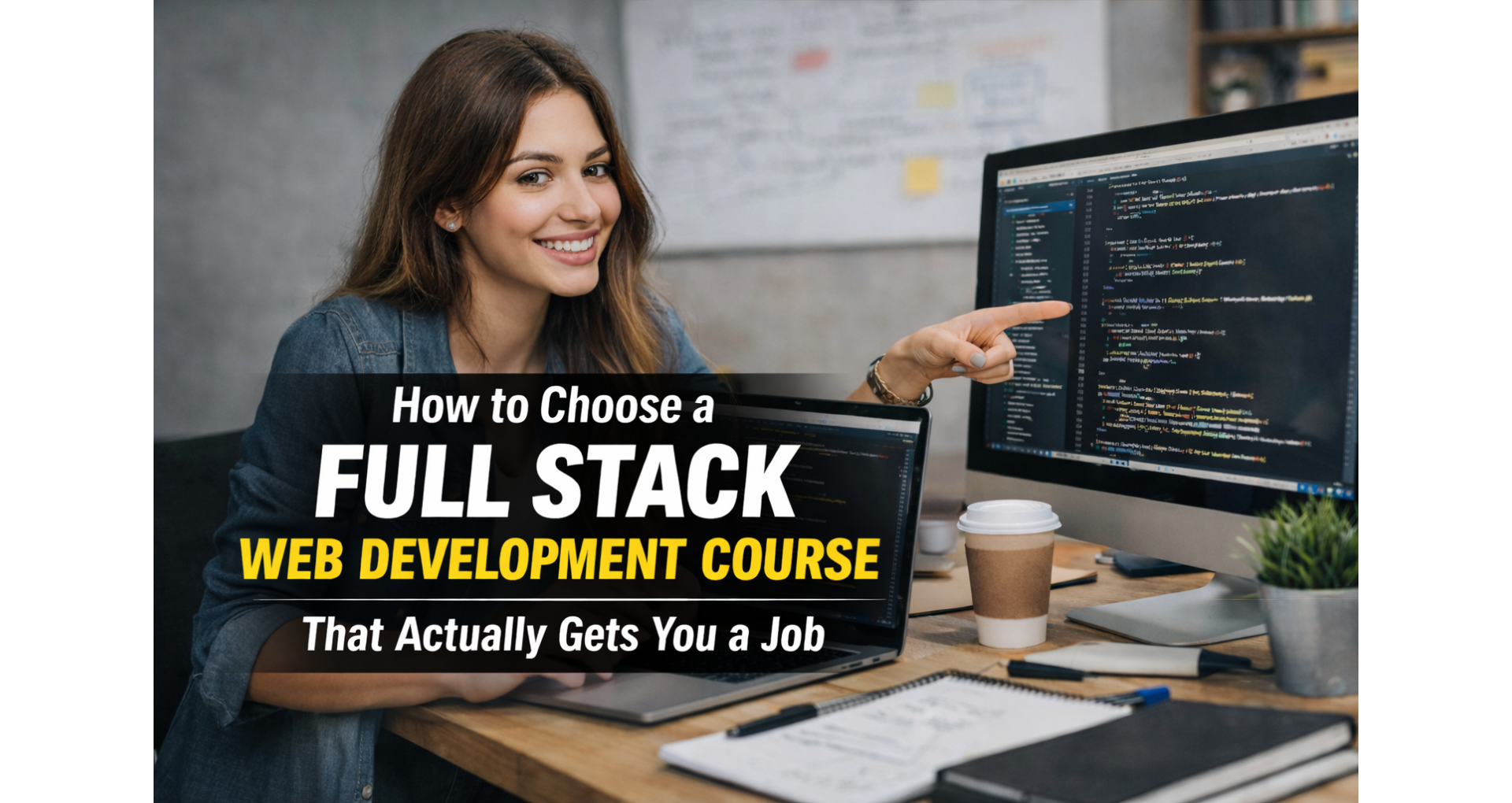
How to Choose a Full Stack Web Development Course That Actually Gets You a Job
1. The Curriculum: Depth Over Breadth
Many courses promise to teach you "everything", but a jack-of-all-trades is often a master of none in the eyes of a recruiter. A job-ready curriculum should focus on a modern stack (like MERN or Python/Django) and go deep into how these technologies communicate.
Beyond just HTML, CSS, and JavaScript, look for modules that cover:
- Version Control: Using Git and GitHub in a collaborative environment.
- Database Management: Understanding how to structure data in SQL or NoSQL.
- Deployment: Knowing how to take a project from a local folder to a live URL.
2. Prioritize Project-Based Learning
Reading documentation and watching videos will only get you so far. To get hired, you need a portfolio that proves you can solve real-world problems.
When evaluating a Full Stack Web Development Course, look at the capstone projects. Are students building generic "To-Do" lists, or are they building complex, multi-user applications with authentication and API integrations? Employers want to see that you can handle the "logic" of an application, not just the "layout."
3. The Power of a Specialized IT Training Institute
While self-paced learning is great for some, many successful developers find that a structured environment yields better results. Choosing a reputable IT Training Institute often provides the accountability and mentorship that YouTube tutorials lack.
In an institute setting, you gain access to:
- Industry Mentors: People who currently work in the field and know what hiring managers are looking for.
- Structured Timelines: A clear "start" and "finish" date to keep you motivated.
- Peer Networking: Your classmates today are your professional network tomorrow.
4. Modern Mobile Integration
The line between web and mobile is blurring. Today’s full-stack developers are often expected to understand how web backends serve mobile frontends. If you want to stand out, look for a course that touches on cross-platform development.
For instance, understanding how to build the best flutter UI can make you an incredibly versatile asset. Flutter allows you to use a single codebase for web, iOS, and Android. A developer who can build a robust backend and then wrap it in a beautiful, high-performance mobile interface is far more employable than one who only knows the browser.
5. Career Services and Job Support
A course that "gets you a job" usually has a dedicated career support wing. Before you hand over your tuition, ask the following questions:
- Do they offer resume workshops? (Tech resumes are different from standard ones).
- Are there mock interviews? (Coding interviews require specific algorithmic practice).
- Do they have hiring partners? (Some institutes have direct pipelines to local tech firms).
6. The "Proof of Concept" (Reviews and Alumni)
Don't just look at the testimonials on the course’s landing page they are curated to look perfect. Instead:
- Go to LinkedIn: Search for the course or institute and see where their alumni are currently working.
- Reach Out: Send a polite message to a former student. Ask them, "Did the course prepare you for the technical interview?"
- Check Third-Party Reviews: Use sites like Switchup or Course Report to get an unfiltered view of the student experience.
7. Price vs. Value
Price is a factor, but it shouldn't be the only factor. A free course that takes two years of trial and error might actually be "more expensive" in lost wages than a paid three-month intensive program that gets you a $60,000 junior role immediately.
Think of your education as an investment. Calculate the ROI (Return on Investment). If the course costs $2,000 but leads to a job within six months, it pays for itself in your first month of employment.
Conclusion
Choosing the right path is the most important "code" you will ever write. By focusing on a rigorous curriculum, choosing a professional environment like a dedicated institute, and expanding your skills into areas like mobile UI, you position yourself as a top-tier candidate.
The tech world is waiting for developers who can solve problems, not just people who can copy-paste syntax. Choose a course that challenges you, supports you, and ultimately, prepares you for the first day of your new career.